
“Resonance”
Album (2026)

1.
“At the Crossroads”

Lyrics
“At the Crossroads”
Two mountains rise in secret skies
Two cloisters hide their way
One speaks the truth the other lies
But I can’t tell today
I climbed until the paths were two
The silence pressed like stone
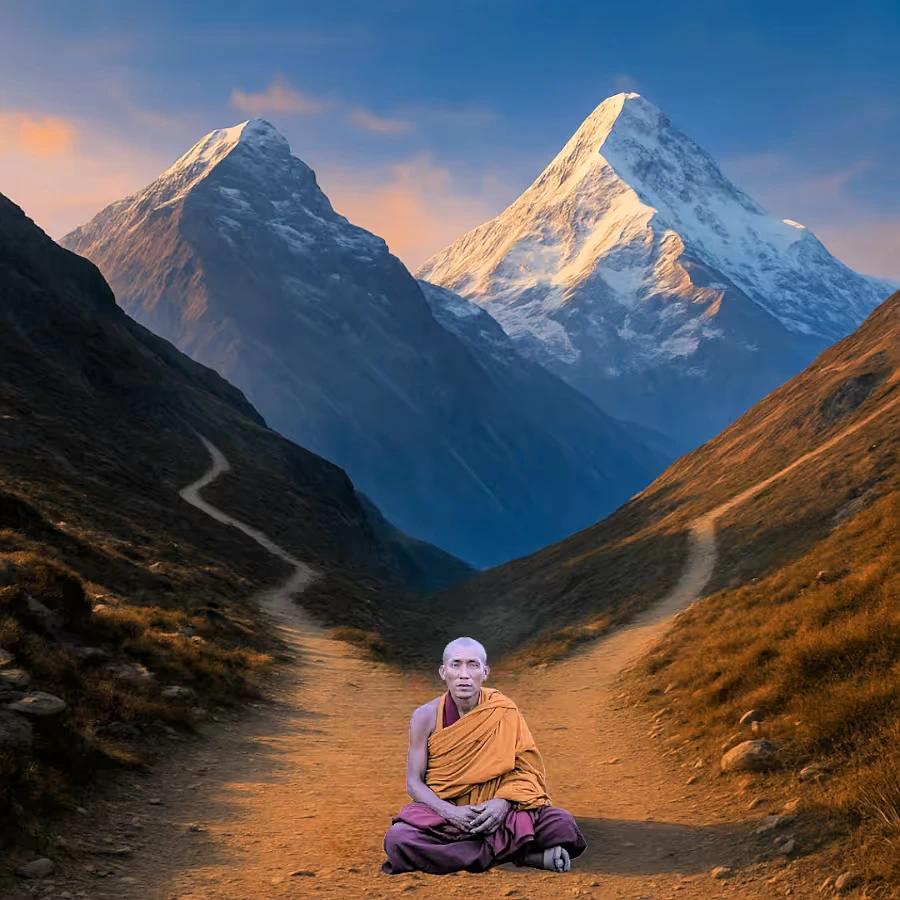
A monk was waiting in the blue
One question mine alone
Does he live in the house of truth
Or dwell where the liars meet
His word may be light or shadow’s sleight
A mask I can’t defeat
Here I stand where the crossroads run
One chance and only one
His lips will move his voice will fall
But I can’t read the sign
The answer may be none at all
Or perfect clear divine
If he is false or if he’s true
His face will never show
The burden lies in what I do
And which way I must go
Does he live in the house of truth
Or dwell where the liars meet
His word may be light or shadow’s sleight
A mask I can’t defeat
Here I stand where the crossroads run
One chance and only one
The weight of a single moment
The turn of a fragile breath
Between the omen and echo
I gamble with life and death
I asked my question and held my breath
His voice rang clear yet strange
I heard the path in his reply
And chose the other way
You’d like to know what I had asked
Well think it through yourself
Either monk would say the same
And so I found my way
Interpretation
At the Crossroads – On Truth, Decision, and Understanding
A wanderer climbs into the high Himalayas, where the air grows thin and the world turns silent. There, two paths lead to two monasteries: in one, the monks always tell the truth; in the other, they always lie. At the fork sits a solitary monk, and the traveler may ask him only one question.
This ancient logic puzzle – told in countless variations – forms the narrative frame of At the Crossroads.
Yet the song is not primarily about solving the riddle. It is about what lies behind its logic.
Yes, on the rational level, the puzzle has a clear solution: with the right question, one can find the true path.
But while logic may solve the problem, it cannot resolve the experience of uncertainty itself.
The song dwells in that tension — between the clarity of reason and the unease of choice.
The traveler’s struggle with the monk’s voice is not born of ignorance, but of recognition: the realization that every question about truth is also a question about trust.
The crossroad becomes a symbol of those moments when one must choose a direction, knowing that certainty is out of reach.
“Does he live in the house of truth, or dwell where the liars meet?”
The refrain is addressed not only to the monk, but to the world — to every source of authority that claims to know.
As in logic, so in life: truth and falsehood often wear the same face.
When the answer finally comes, it is not a victory of cleverness but of understanding.
In the line “I heard the path in his reply, and chose the other way,” the paradox unfolds: one finds truth only by seeing through illusion.
The riddle is solved, yet its meaning opens wider.
The closing words — “You’d like to know what I had asked? Well… think it through yourself” — turn the story back on the listener.
The puzzle is resolved, but its significance remains personal.
Logic reveals the way; reflection reveals why that way matters.
At the Crossroads thus transforms a classic riddle into a meditation on knowledge, trust, and self-awareness.
It unites intellect and emotion, certainty and humility.
The monk at the fork no longer stands for the opposition between truth and lies, but for the silence that follows understanding — the moment when knowing gives way to being.
2.
“What If”

Lyrics
“What If”
Dedicated to the pioneers of the unknown seas, to Rosa Parks, and to Mahatma Gandhi — with deepest respect and reverence.
They warned us softly: Don’t go far
The edge is waiting where the waters are
Beyond the line the world just ends
A drop into nothing no way back again
Yet still the sails were trembling with desire
The horizon whispered pulling higher
And every fear that kept us near
Was smaller than the wind we steered
What if the map was never true
And every road could lead us through
We’d never hear the song of the wind
If no one ever let it in
They told her: Move! This place’s not yours
A quiet body blocked their doors
No shout no fight no blade no flame
Just stillness tearing rules to shame
And in that pause the ground was split
A thousand voices rose from it
One seated spark so small so slight
Yet everything began that night
What if we all just stayed in line
Afraid to cross the do not sign
We’d never trip we’d never fly
We’d never taste the other side
They raised their fists their iron hand
Yet he stood still refused command
No sword no shield no hate no fight
Just silence burning twice as bright
The deeper strength was not to win
But free the enemy within
A barefoot path unarmed unshod
Yet every step was full of God
What if the answers hide in the unknown
And every step could build a world of our own
We’ll never know how far we can run
If no one dares to chase the sun
Every frontier starts inside
Where we choose to run or hide
Every “what if” is a key
Unlocking more of who we’ll be
What if we never dared to go
‘Cause everyone said “stay below”
We’d never find the place we’d be
If no one walked to see what we could see
What if the answers hide in the unknown
And every step could build a world of our own
We’ll never know how far we can run
Unless we rise to chase the sun
Interpretation
Interpretation: “What If” – The Courage to Cross the Horizon
The song “What If” is a meditation on courage, conscience, and the power of stepping beyond fear.
Inspired by the Swiss poet Kurt Marti’s reflection
“Where would we go if everyone said, where would we go, and no one went to see where we would go if we went?”
the lyrics trace a timeless journey of human bravery: from the first explorers who sailed beyond the edge of the known world, to Rosa Parks, to Mahatma Gandhi.
It is a song about those who dared to walk where no one else would — and by doing so, expanded what was possible for us all.
The Explorers – Into the Unknown
The opening verses recall the first seafarers, warned not to go too far:
“They warned us softly: Don’t go far, the edge is waiting where the waters are…”
Yet they set sail anyway, driven by wonder and the longing for discovery.
Their voyage symbolizes every act of human courage — the willingness to cross the line between safety and possibility, to prove that the world does not end at the horizon.
Rosa Parks – The Quiet Power of Defiance
The song then moves from oceans to streets:
“They told her: Move! This place’s not yours… Just stillness tearing rules to shame.”
This verse evokes Rosa Parks, whose simple refusal to give up her seat became a turning point in the struggle for civil rights.
Her silence, her calm, her dignity — these became weapons stronger than violence.
Through her, the song reminds us that stillness can shake an empire, and that moral courage often begins with one quiet “no.”
Mahatma Gandhi – Strength Without Violence
Later, the lyrics portray a man who resists with no sword, no hate, no shield:
“Just silence burning twice as bright.”
This figure recalls Mahatma Gandhi, who transformed the world through nonviolent resistance.
The song honors his conviction that real victory lies not in defeating others, but in freeing the enemy within — overcoming hatred, fear, and the will to dominate.
“A barefoot path unarmed unshod, yet every step was full of God.”
Each step becomes a sacred act of courage, a gesture of peace made powerful through faith.
The Universal Message – Every Frontier Begins Within
The repeated question “What if…” is the heart of the song.
It challenges the listener to imagine what might happen if no one dared, if everyone stayed behind the lines drawn by fear and habit.
“Every frontier starts inside, where we choose to run or hide.”
The message is clear: the greatest boundaries are not on maps but in the human heart.
The unknown — whether a distant horizon or a moral stand — becomes the place where we discover who we are meant to be.
Conclusion – The Song of the Brave
“What If” spans centuries and continents, connecting explorers, activists, and visionaries in one unbroken story of courage.
It reminds us that every great journey — across oceans, across injustice, across the limits of the self — begins with one question: What if I go?
If no one had set sail, defied the rules, or walked in peace against power, the world would still be smaller — not only on the map, but in our hearts.
The song’s final message echoes Marti’s vision:
Only those who walk will ever know where the road can lead.
Feedback
Hey folks, want to hear the perfect song? Yes, there may be a few, but What If by aimaze is one of them. Definitely!
Short, snappy—perfect. A stunningly confident voice that delivers sophisticated lyrics so well that you can completely lose yourself in them. Add to that a rhythm that seems to come from deep within, rock, jazz, soul — all combined, irresistible.
So, I can’t get enough of it, but I limit myself to six energizing sessions a day. Since then, I don’t need anything else. 😉
Feel free to disagree if you dare!
Nils C., 2025-10-06
3.
“The Same Air”


Lyrics
“The Same Air”
I have eyes that open to the morning light
You do too
I have hands that tremble when the night is long
You do too
I breathe in the same air that carries you
I have fears that whisper in the dark
You do too
I have dreams that climb beyond the stars
You do too
And when silence falls, we can listen through
Who am I, who are you?
In the stillness I can hear the song of you
Look at me, look at you
We are rooted in the same ground too
I have oceans rising in my chest
You do too
I have constellations hidden in my rest
You do too
The earth beneath my feet is holding you
Maybe we are mirrors, facing one another
Pieces of a puzzle, falling into color
Every broken shard is shining through
Who am I, who are you?
In the stillness I can hear the song of you
Look at me, look at you
Every joy returns to where it grew
We all, we all, we all have eyes
That open to the morning light…
Interpretation
“The Same Air”
“The Same Air” is a poetic meditation on human connection — a quiet reflection on how, beneath all differences, we share the same breath, the same fears, and the same dreams.
Through simple yet intimate parallels — “I have eyes that open to the morning light / You do too” — the song dissolves the boundary between “I” and “you.” It invites the listener to recognize the shared pulse that moves through every living being.
The recurring question, “Who am I, who are you?”, doesn’t seek separation but unity. It’s a moment of awareness — a reminder that identity, in its truest sense, arises from relationship, not isolation.
As the song unfolds, the imagery expands from the personal to the cosmic: oceans rising in the chest, constellations hidden in rest, the earth holding both “you” and “me”. These metaphors weave a vision of profound interconnection — physical, emotional, and spiritual.
By its end, the refrain “We all have eyes that open to the morning light” becomes a gentle affirmation of hope — a recognition that every human experience, no matter how solitary, resonates within a shared field of life.
4.
“The Quiet Light”


Lyrics
“The Quiet Light”
A hand in the dust,
a whisper in the noise.
The sky folds inward,
listening.
Someone says: it’s too late.
Someone else lights a match.
I stand between them,
holding an invisible seed.
I plant what cannot be measured,
I trust what cannot be named.
The world won’t wait for permission,
it turns,
it breathes,
it forgives.
Every motion leaves a trace.
Even silence carries weight.
I will move,
though no one sees.
Beneath all plans and numbers
runs a river that remembers.
It hums in the roots of trees,
it hums in me.
I do not own its current.
I only open my palms,
and let it pass through.
What if faith
is simply breathing,
when there’s no air left to borrow?
What if grace
is doing what must be done,
and not asking who will follow?
I will do the work,
and let the wind decide.
Somewhere unseen,
the tide remembers its way home.
The stars lean close,
and bless the hands that try.
I am not the harvest,
I am the soil that waits.
I am the candle’s breath,
tracing light through air.
There is no ending here,
only the soft return.
The quiet light remembers
every kindness left unspoken.
I walk on,
without reward,
without regret,
and bless what I can’t know.
Interpretation
The Quiet Light – A Song About Acting in Trust
Some songs need to shout to be heard — others shine precisely because they remain quiet.
The Quiet Light belongs to the latter kind.
It is not a call to arms, not a manifesto or a sermon.
It is a conversation with the soul — about responsibility, trust, and the power of small, unseen actions.
The song begins with a simple image: someone planting what cannot be measured.
No visible fruit, no tangible success — only a gesture that carries meaning within.
“I plant what cannot be measured.”
It is the voice of a person who chooses to act without knowing if their actions will ever make a difference.
That kind of courage is rare — not the courage to assert, but the courage to surrender to life.
Beneath all human plans and numbers, the song says, runs a hidden current — a force that remembers and connects.
It represents something larger than will or reason:
the quiet rhythm that moves through all things.
“I only open my palms, and let it pass through.”
That is not resignation — it is consent.
A deliberate yes to the flow of things.
At the heart of the song lies perhaps its softest line:
“What if faith is simply breathing, when there’s no air left to borrow?”
Faith here is not belief as conviction, but belief as movement — the act of continuing when all reasons have dissolved.
It is the trust that meaning need not be visible to be real.
As the song unfolds, this insight becomes a form of quiet awakening.
The world begins to answer:
The tide remembers its way home, the wind recalls its name, the stars incline again.
And the one who at first was searching realizes they are not a witness, not a victim, not a hero —
but part of the whole:
“I am not the harvest — I am the soil that waits.”
The ending brings no crescendo, only a soft return.
“There is no ending here, only the soft return.”
The “quiet light” is not an outer radiance, but the inner awareness that rises when we act without seeking reward.
It is the light of humility, of presence, of silent trust.
The Quiet Light reminds us that not every fire must roar to give warmth —
that the world is also changed by those who simply do what must be done,
without certainty, yet with an open heart.
5.
“The Task Ahead”


Lyrics
“The Task Ahead”
You say: What difference could I make?
The river’s wide, your hands are small.
You fear your step will change not all,
Yet mountains wear by grains of sand.
You search for signs in other eyes,
To see if they will start before.
But waiting builds another wall
Between your will and what you prize.
The task ahead is never wide,
When courage walks beside your name.
The power behind you burns the same —
A quiet fire deep inside.
No crown awaits, no easy win,
No trumpet calls the work you do.
But something vast is born through you —
Each act a seed, each loss a kin.
So lift your hand though skies are dim,
Though no one cheers the path you tread.
The world moves on by those who’ve said:
“The storm is great — I’ll still begin.”
The task ahead is never wide,
When faith is stronger than the fear.
You’re not alone — the truth is near:
The power behind’s your guide.
When you walk on, don’t count the ground,
Nor weigh the miles, nor doubt the thread.
The work begins where faith is found —
You are the task ahead.
Interpretation
The Task Ahead – A Song Against Powerlessness
We live in a time when the challenges before us seem almost too vast to face —
climate change, division, conflict, a growing loss of meaning and trust.
Many people quietly ask: What could I possibly do?
And so, they do nothing — not out of indifference, but out of disbelief that their actions could matter.
The Task Ahead is a song against that paralysis.
It reminds us that real change rarely begins with noise, but with one small, deliberate step.
“You say: What difference could I make? / The river’s wide, your hands are small.”
And the answer comes like a whisper of truth:
“Yet mountains wear by grains of sand.”
Even what seems immovable can be reshaped — through patience, persistence, and countless acts of quiet courage.
This song is meant to restore faith — not the loud kind, but the steady trust that every action counts, that meaning unfolds through doing, and that the power behind us is greater than the scale of the task.
It closes with a gentle reminder:
We are not bystanders in this world — we are part of its healing.
“The work begins where faith is found — you are the task ahead.”
It’s not a command — it’s an invitation.
6.
“A Great Song”

Lyrics
“A Great Song”
Lyrics by Rainer Maria Rilke (original German text, translations by ChatGPT)
Ich lebe mein Leben in wachsenden Ringen,
die sich über die Dinge ziehn.
Ich werde den letzten vielleicht nicht vollbringen,
aber versuchen will ich ihn.
Ich kreise um Gott, um den uralten Turm,
und ich kreise jahrtausendelang;
und ich weiß noch nicht: bin ich ein Falke, ein Sturm
oder ein großer Gesang.
English
I live my life in widening circles
that sweep across all things.
Perhaps I shall not finish the final one,
but I mean to try.
I circle God, the ancient tower,
circling for millennia;
and I still do not know: am I a falcon, a storm,
or a great song.
French
Je vis ma vie en cercles croissants
qui se meuvent au-dessus des choses.
Je n’accomplirai peut-être pas le dernier,
mais je veux l’essayer.
Je tourne autour de Dieu, autour de la tour immémoriale
et je tourne depuis des siècles;
et je ne sais toujours pas: suis-je un faucon, une tempête,
ou bien un immense chant.
Spanish
Vivo mi vida en anillos crecientes
que se extienden a través de las cosas.
Quizás no pueda completar el último,
pero lo intentaré.
Giro en torno a Dios, alrededor de la antigua torre;
y llevo milenios girando;
y aún no sé: ¿soy un halcón, una tormenta
o una gran canción?
Russian
Я проживаю жизнь свою в кругах растущих,
что ширятся над всем, что есть.
Быть может, я не завершý последний —
но я стремлюсь к нему.
Вокруг Тебя, о Боже, вокруг древней башни,
я кружу тысячелетия;
и всё ещё не знаю: я — сокол, я — буря,
или великое пенье?
Chinese (Mandarin)
我活着,生命一圈圈扩展,
环绕万物,层层展开。
也许我永远无法完成最后一圈,
但我愿去尝试。
我绕着上帝
那古老的塔
旋转,
已经千年;
而我仍不知:我是鹰?是风暴?
还是一首伟大的歌?
Interpretation
No interpretation provided for this text; it speaks for itself. Just let it sink in.
7.
“Solaris”
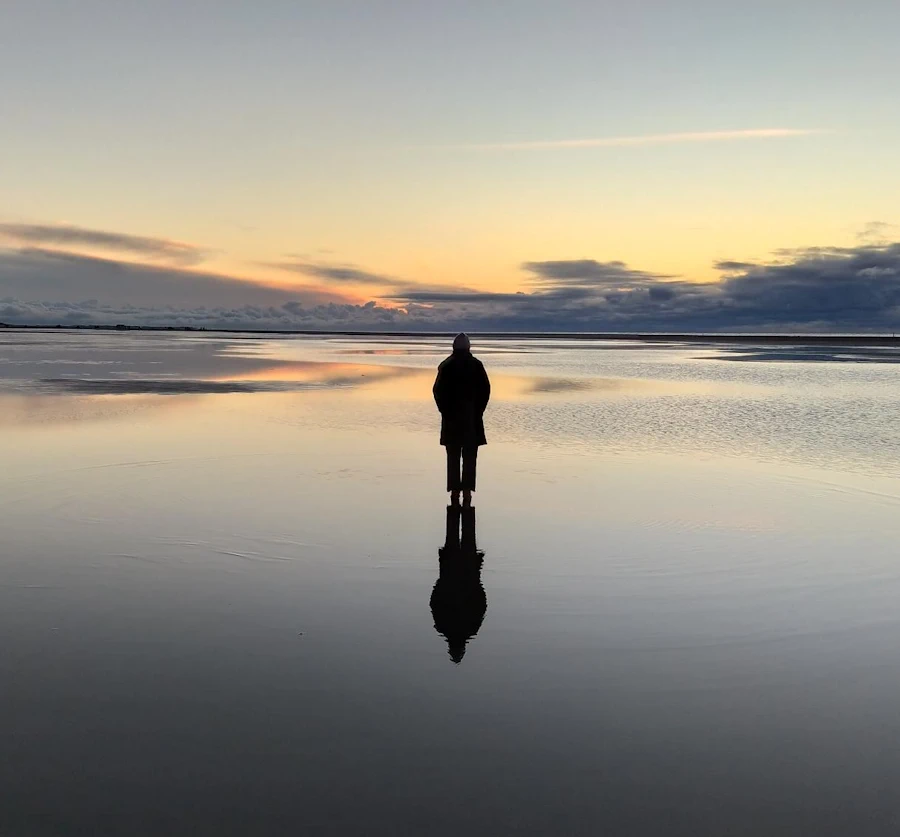

Lyrics
“Solaris”
Inspired by the novel of the same name by Stanisław Lem
In the hush before thought forms a name
You rise — an outline carved from the absence of shape
I kneel inside the trembling of my own mind
Feeling the seams of what I am
Begin to loosen
You are not a voice but a pressure in the air
A slow turning lantern of impossible light
Each fragile breath releases something
Threads of memory strands of certainty
The small shell I’ve mistaken for myself
If I open too wide I fear I’ll vanish
If I don’t I’ll never touch you
So I stand at the threshold
My shadow thinning
Into invitation
Let me dissolve enough to meet you
Not in body not in language
But in the quiet where origins fade
If understanding demands my unmaking
Then unmake me gently
I have carried myself long enough
You move like a tide that remembers before time
Folding and unfolding the shapes of meaning
In your nearness even gravity listens
Waiting for a truth
That has no need of words
I feel you sensing the outline of my longing
A fragile pulse pressed against an infinite shore
And I realize knowledge is not a conquest
But a surrender
To what cannot be held
Let me dissolve enough to meet you
Not in body not in language
But in the quiet where origins fade
If understanding demands my unmaking
Then unmake me gently
What if the self is only a boundary
Drawn in fear of the vast
What if contact is a soft erasure
A widening
A letting go
That becomes a kind of prayer
If you reach for me again
You will find me open
A ripple becoming its own horizon
A question finally unafraid
To be answered
By silence
Interpretation
Solaris — A universal ritual of opening
Solaris speaks of something older than words and larger than any single life: the moment in which consciousness remembers its origin. It describes a state shared by all beings when they encounter something beyond their concepts — a field of otherness that does not threaten us, but calls to us.
At the beginning stands the silence before all form. A silence in which the world is still unnamed and we ourselves exist only as a faint suggestion. From this depth a distant counterpart rises, formless, a mere hint of possibility. It is the sense that the universe itself sometimes looks back at us — not with eyes, but with presence.
When we meet this presence, we meet it with our shared fragility. Everything human — memory, habit, the boundaries we have drawn with such care — begins to shift. Not as a loss, but as a veil loosening to reveal that something more fluid lies beneath. In this moment, we do not grow smaller — we grow wider.
Again and again, Solaris leads us to an inner threshold: that ancient place where we sense that we are not truly separate. A place that asks less who we are than who we might become if we loosen the tight hold of our own identities. It is the borderland of all spiritual experience: the moment in which we dare to open ourselves, even without knowing what will meet us there.
What meets us is not a being in any conventional sense, but resonance — a silence that supports, a movement that shapes meaning without ever requiring a word. Here arises a form of knowing that is not gathered but received: a knowledge born when we expand in trust rather than retreat into boundaries.
The song suggests that the “self” may not be a fixed form at all, but something outlined out of fear of the infinite. Yet the infinite is not hostile. It is the space from which we emerged and into which we may expand. When this line softens, nothing breaks; instead, we return to a greater coherence.
Toward the end, Solaris widens our view to a mode of awareness no longer defined by individual limits. We become movement within the great breath of the universe, waves of light and meaning forming their own horizon.
Here, silence is not a final word, but the vast origin in which meaning rests undivided.
In this sense, Solaris invites into an ancient spiritual gesture: the release of what we believe to be our true measure, and the recognition that we are part of a much larger field — one that touches us when we allow ourselves to become permeable.
It is a song about the widening of consciousness, the courage of gentleness, and the quiet dignity that arises when we do not close ourselves to the mystery, but answer it — with openness and surrender.
8.
“Kate”


Lyrics
“Kate”
Inspired by Charles Eisenstein’s essay “Undefeated”.
For all flower children, with great respect, deep affection, love, and gratitude. ❤️
Lyrics:
She was young with flowers in her hair
Sixty-seven, summer in the air
Married a painter with a cosmic grin
Said we’ll raise the light from the land we’re in
He carved the wood, she held the days
Five small lights in endless waves
Dreams like banners in the wind
Never thought how thin they’d get
They said be patient, love will pay
But patience doesn’t earn a wage
Oh Kate, you were not wrong
You were just early, and the road is long
The world broke faith, not you
Every tear you cried was true
Oh Kate, you stayed when no one knew
What you gave keeps coming through
In every child you held at night
You sent a pulse of future light
Now the kids are busy staying afloat
Two jobs, tired eyes, tight throats
She grows her roses by the road
Priced in hope, but nobody slowed
Her hands still know how life begins
How to quiet fear, how to listen in
But the market doesn’t need that skill
So she learns the shape of standing still
She asks the sky, was it a lie?
The age of love, the promised time
Oh Kate, you were not wrong
You were just early, and the road is long
The world forgot what it once knew
But love remembers what to do
Oh Kate, don’t call it waste
Nothing gentle leaves no trace
Every hour you gave away
Is breathing somewhere today
They call it “growing up”
When you bury what you felt
They call it “real life”
When you learn to doubt yourself
But what if hope was never naïve
Just unfinished, incomplete
What if all those golden dreams
Are seeds asleep beneath our feet?
Every touch becomes a trace
Every kindness finds a place
Nothing given disappears
It stays behind our eyes and years
Oh Kate, and everyone
Who loved when no one was watching on
The world is more than what we see
It’s shaped by how we choose to be
Every act of love remains
In the child, the dying, the stranger’s face
It tells the dark, it tells the stars:
This is the shape of the human heart
It pulls tomorrow into tune
With something ancient, something true
Interpretation
Kate is a song about a life that did not turn out as promised—and about why that does not mean it failed.
At its surface, the song tells the story of one woman shaped by the ideals of the 1960s: a flower child who believed that love, creativity, and care could help usher in a more humane world. She married young, raised children, carried households, endured scarcity, addiction around her, and the slow erosion of youthful certainty. Her life looks, by the usual metrics, unremarkable and economically unsuccessful. The great transformation she hoped for did not arrive.
But the song resists the easy conclusion that this makes her story tragic.
The deeper current of Kate comes from the insight that disappointment is not the same as delusion. The original essay that inspired the song argues that modern society often treats 1960s idealism—and idealism in general—as childish fantasy, something to “grow out of.” We tell ourselves this dismissal is realism. Yet the song asks a quieter, more unsettling question: is it realism, or is it grief that never found language?
Kate’s grief is not only personal; it is generational. She represents countless people—especially women—whose lives were spent doing work that is foundational but invisible: raising children, caring for grandchildren, holding families together, offering patience without applause. The world tends to value visible achievement, money, and influence, while ignoring the slow, repetitive labor that actually forms human beings. Kate names this imbalance without anger, choosing instead to restore dignity.
The turning point of the song is its refusal to measure worth by outcomes. The line “You stayed when no one knew / What you gave keeps coming through” reframes success as transmission rather than accomplishment. Love, the song suggests, does not disappear simply because it does not culminate in a utopia. Every act of care lodges somewhere—in children, in communities, in the future itself. Even when no conscious memory remains, something essential has been passed on.
This is where the song opens from biography into philosophy. The final sections move beyond Kate as an individual and speak to anyone who has loved without recognition. The idea echoes the original essay’s core insight: that history’s unfinished dreams are not wrong dreams. The visions of a more compassionate world—whether from the 1960s or from any other “golden age”—may not be realized in a single lifetime, but they remain real possibilities, kept alive by ordinary acts of love.
The closing image, “This is the shape of the human heart,” is not sentimental. It is declarative. The song insists that care itself is a form of truth-telling. To love patiently, especially when it goes unnoticed, is to assert something fundamental about what it means to be human. In that sense, Kate is not a song about defeat, but about continuity: how the future is quietly shaped by people who never thought of themselves as heroes.
Ultimately, Kate invites the listener to reconsider whose lives count as meaningful. It suggests that the work that rarely earns money, praise, or history-book recognition may be the very work that keeps the world capable of becoming something better.
9.
“Ignorance”


Lyrics
“Ignorance”
Inspired by a poem by Rumi
Lyrics:
I didn’t know love would carry me this far
Eyes like a river losing its source
The current takes what I called my name
Pieces of a boat learning to let go
No shore in sight
No map that knows me
I’m drawn into a widening blue
Where answers lose their weight
Something ancient turns below
Breathing slow
The floor of the sea becomes a desert
What was deep turns endless
Changes do happen
Without asking why
I hear so many stories
Built from reasons and names
I let them pass
Like weather through me
I don’t know anything
And the weight falls away
I don’t know anything
And the ground feels wide
There is comfort
In not explaining
Something I took in from the ocean
Salted my blood with silence
No questions knocking
No answers waiting
I don’t know anything
And I feel at home
Carried by what I can’t explain
Completely content with ignorance
Interpretation
Ignorance as Fulfillment
The song Ignorance unfolds as a meditation on surrender—on the moment when the desire to understand gives way to the deeper need to rest. Its central gesture is paradoxical: ignorance, normally framed as lack or failure, is reimagined as a condition of peace. This inversion places the song in direct conversation with mystical traditions, most clearly with the Sufi thought articulated by Rumi, while remaining firmly grounded in a contemporary, human voice.
At the heart of the song lies an experience of being overtaken. Love appears not as comfort or certainty, but as a current—something that carries the speaker beyond intention and control. The repeated water imagery does not merely suggest emotion; it signals dissolution. Names, maps, explanations, and solid ground all fail. What is lost is not only orientation in the world, but orientation in the self. The speaker does not *choose* to let go; letting go happens as a consequence of being moved by something larger.
This movement echoes Rumi’s imagery of the river and the ocean, where identity is shattered like a boat breaking apart in rapids. In both texts, water is not symbolic in a decorative sense; it is transformative. To enter it is to accept that previous structures—intellectual, emotional, spiritual—will not survive intact. Importantly, this loss is not framed as tragedy. It is presented as a necessary unmaking.
As the song progresses, it shifts from turbulence to stillness. Voices appear—stories, reasons, names—attempts to impose order on the experience. These voices mirror what Rumi describes as “so many stories and explanations,” all circling the ineffable without touching it. The song’s response is not argument but silence. The speaker does not refute these narratives; they simply let them pass. Silence here is not emptiness, but discernment—the recognition that explanation cannot substitute for presence.
The refrain-like lines “I don’t know anything” mark a crucial turning point. Spoken plainly, without irony or despair, they function almost as a mantra. This is not the ignorance of avoidance or denial, but of release. The weight that falls away is the burden of coherence itself: the need to make experience intelligible, defensible, and narratable. In relinquishing that need, the speaker finds the ground widening beneath them. Stability emerges not from knowledge, but from the absence of resistance.
This is where the song most closely aligns with Rumi’s concluding insight: contentment born from something “swallowed in the ocean.” In both cases, the decisive change is internal and wordless. There is no revelation in the form of doctrine or insight. What replaces understanding is a bodily, almost somatic peace—salt in the blood, silence smoothing sharp edges. The transformation is subtle but irreversible.
The closing affirmation—being “completely content with ignorance”—is therefore not an endpoint but a resting place. It does not resolve the mystery of love, existence, or selfhood. Instead, it affirms a different relationship to mystery itself. Ignorance becomes spacious rather than limiting, gentle rather than threatening. It is the condition in which the self no longer needs to hold the world together.
In this sense, *Ignorance* is not a song about knowing less, but about trusting more. It suggests that there is a form of wisdom that emerges only after the collapse of certainty—a wisdom that does not speak loudly, does not argue, and does not explain. It simply remains. Like the tide at the end of the song, it breathes in and out, carrying the listener not toward answers, but toward acceptance.
The song thus stands as a contemporary echo of a very old insight: that peace is not found by mastering the world, but by consenting to be moved by it.
10.
“A New Flute”

Lyrics
“A New Flute”
Inspired by an ancient parable
Lyrics:
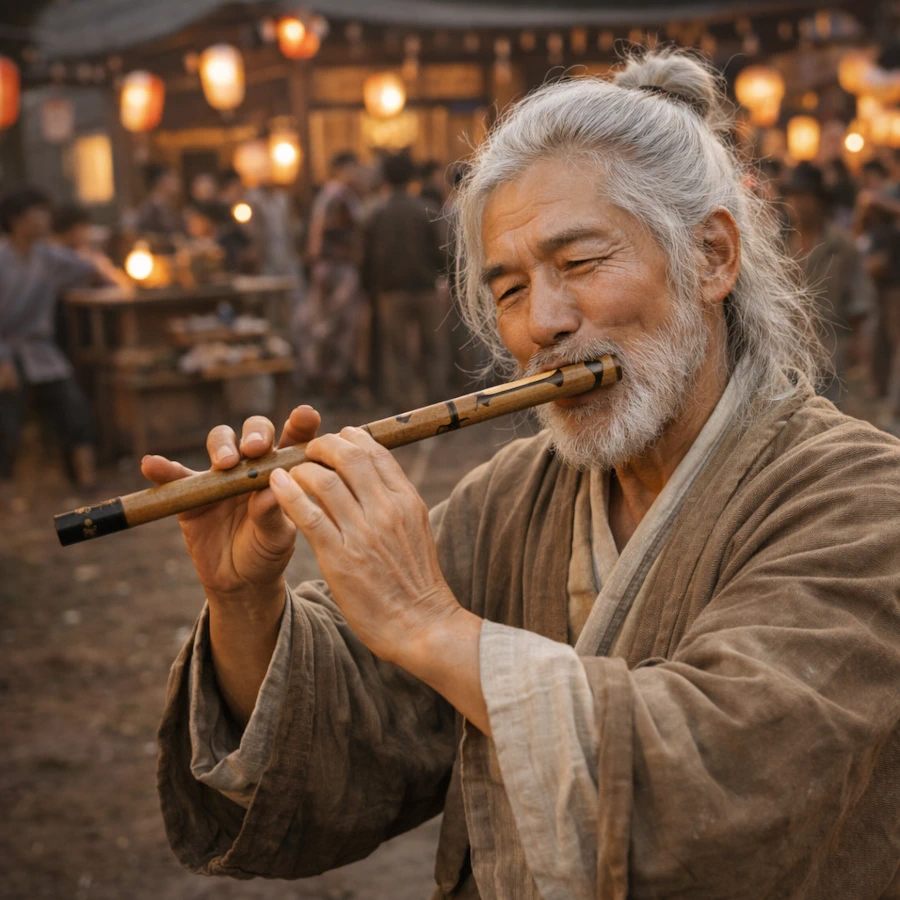
There was a new flute
He brought it from China
A master of breath
He played like a god
I was a gifted boy
Hungry to learn
To sound like him
For perfection
For fame
I learned the shape of every sound
The weight of breath, the count of time
I held the notes like fragile things
Afraid they’d fall if I let go
But something was lacking
Like a bell that wouldn’t ring
Like a door I couldn’t find
I tried to fill the space between the note
And what it meant to be
But wanting has a gravity
It pulls the music down
Something is lacking
I don’t know what
I follow the rules
But I miss the spot
Every tone is in place
Still it won’t move
I play and I play
But it won’t come through
I practiced every way I knew
Till effort lost its name
Still every note came back to me
Sounding much the same
Something is lacking
Or so it seems
I reach for the sound
And wake the need
If I stop asking
Will it appear?
If I stay here
Will it come near?
I quit, I gave up
Unsettled, ashamed
I broke myself open
And drifted away
I stumbled back home
Taught beginners to play
For a living
For years
Then one night, a knock at my door
A village feast, an invitation
I reached for a flute
It was the one
With nothing left to walk away
No face I had to save
No future leaning on this sound
No past I had to brave
Just breath meeting wood
And time standing still
As if the sound knew
What I never will
Something was lacking
So I let it be
I played the same notes
And they played me
With nothing to prove
And nothing to lose
I played like a god
And dissolved in resonance
Interpretation
Dissolving into Resonance
“A New Flute” presents itself as a story about music, but it gradually reveals a deeper scope. What unfolds through the figure of the flutist is not only an artistic initiation, but a meditation on how life itself comes into alignment. Music here is not a metaphor applied from the outside; it is the very medium through which the song speaks about living, striving, failing, and finally allowing.
At the beginning, the world of the song is defined by hierarchy and idealization. The master musician appears almost mythic, “a master of breath”, whose playing provokes awe and reverence. He is not merely skilled; he is elevated to something divine. For the young narrator, this encounter sets the terms of his quest. Music—and, implicitly, life—is something to be achieved. Identity is bound to excellence, and meaning is expected to arrive through perfection and recognition.
The apprenticeship that follows is deliberately narrow. The master gives only one tune, a constraint that strips both music and life of variety and distraction. Repetition replaces progress. Although the narrator learns control, timing, and discipline, something essential remains absent. The recurring phrase “something is lacking” functions like an unanswered question posed not just to the music, but to existence itself. The lack cannot be repaired by effort. Wanting, the song observes, has gravity—it pulls everything down, sound and life alike.
The choruses articulate a familiar modern condition: everything appears to be in place, yet nothing moves. The narrator follows the rules, does what is required, practices relentlessly—and still feels untouched. This is not merely artistic frustration; it is existential dissonance. Life is being performed correctly, but it does not answer back. The more insistently meaning is pursued, the more opaque it becomes.
The turning point does not arrive through insight or mastery, but through collapse. The narrator quits, ashamed and unsettled, drifting away from ambition and self-definition. Years pass in obscurity. He teaches beginners, a role stripped of prestige and expectation, lives modestly, and occupies a space without promise. This period is not portrayed as redemption. Rather, it is a gradual erosion of the self that needed life to confirm its value. In losing direction, the narrator also loses resistance.
When the invitation finally comes—a village feast, a simple gathering—it carries none of the weight of destiny. The narrator reaches for a flute without expectation. What has changed is not the melody or the instrument, but his stance toward life itself. He now stands with “nothing left to walk away”, no image to protect, no future to secure, no past to justify. Time loosens its grip. In this stillness, music is no longer produced; it happens. And life, too, is no longer managed; it unfolds.
The final chorus reframes the central motif. “Something was lacking” is no longer an accusation or a wound, but a condition that can be allowed. By letting it be, the narrator permits a reversal: he does not play the notes; they play him. This inversion marks the emergence of resonance—not as intensity or transcendence, but as participation. The individual no longer stands apart from what occurs.
The closing lines complete this transformation with quiet precision. “I played like a God” echoes the opening image of mastery, but its meaning has shifted entirely. Godliness here is not control or superiority, but disappearance. To “dissolve in resonance” is to let the boundary between self and world dissolve—to become indistinguishable from the movement of breath, sound, and time.
In this sense, “Resonance” is not ultimately about music at all. Music is simply the place where the truth becomes audible. The song suggests that life, like sound, cannot be forced into meaning. It can only be met. When striving falls silent, when breath meets wood without agenda, life responds—not with answers, but with resonance.
